The Decline of Trust in Higher Education
Higher education has become increasingly politicized. With institutions perceived as “liberal,” “conservative,” or “neutral” depending on their location, campus culture, administrative decisions, and public controversies, there is a growing desire to attend an institution that aligns with one’s cultural or ideological beliefs.
Trust in Education
The implications are more significant for small liberal arts colleges. Many of these institutions have reputations for progressive campus culture, which may alienate politically conservative families. At a time when small colleges already face demographic and financial pressures, religious institutions, in particular, stand out within this landscape. While some conservative Christian colleges have seen enrollment stability due to their clearly defined ideological identity, other small religiously affiliated colleges struggle if their theological or political positioning is ambiguous or out of step with regional cultural expectations.
Understanding this distrust requires looking at the historical foundations of higher education in the U.S. Early universities were created primarily for elite, white, male students and were never intended to serve the broader public (Hashemzadeh, 2025). While the expansion of public and land-grant institutions in the 19th century helped widen access, long-standing tensions over who higher education is “for” have never fully disappeared. Today, political rhetoric that labels universities as “elite” taps into these historic divisions, reinforcing public skepticism and shifting the conversation away from meaningful reform toward cultural and political conflict. In an August 2025 memo, the Trump administration accused higher education institutions of being elitist by saying, "President Trump is holding elite universities accountable, ensuring they prioritize fairness, merit and American values." Eric Canny, assistant teaching professor of education at USC Rossier, explains that "By framing higher education as ‘elite,’ Trump and others are tapping into a powerful cultural tension, it plays on longstanding tensions about who higher education is for with a goal of dividing rather than reforming. Important data about access and affordability gets interpreted not to inform policy, but to serve a certain narrative" (Hashemzadeh, 2025).
Over the past two decades, public confidence in higher education in the United States has declined sharply, with recent polling showing that a majority of Americans believe the system is headed in the wrong direction. Data from Pew and Gallup highlight not only a drop in overall trust, but also a growing political divide, with Republicans expressing significantly more skepticism than Democrats, 66% of Democrats, 40% of independents and 26% of Republicans are confident in four-year colleges (Jones, 2025).Despite this, many Americans still believe colleges and universities play an important role in society. This contradiction suggests that while people value the idea of higher education, they are increasingly frustrated with how the system operates in practice.
Rising costs have been one of the most significant drivers of declining trust. Tuition has increased dramatically over the past 20 years, far outpacing wage growth, making college less accessible for low- and middle-income families. Cuts to state funding and the reduced purchasing power of Pell Grants have shifted more of the financial burden onto students and their families (Hashemzadeh, 2025). As a result, many graduates leave college with substantial debt, and those who struggle to find stable employment shortly after graduation often question whether their education was worth the cost.
Although research consistently shows that college graduates earn more over their lifetimes than non-graduates, public perception does not always reflect this long-term data. The focus on short-term job outcomes and immediate return on investment has fueled skepticism, especially during periods of economic uncertainty. Additionally, the growth of for-profit institutions and high-profile failures such as ITT Technical Institute and Trump University have further weakened trust, reinforcing the idea that higher education has become overly market-driven and disconnected from its educational mission.
Political polarization has also played a major role in shaping attitudes toward higher education. College campuses have become visible battlegrounds for culture-war debates surrounding free speech, race, public health, and international conflicts. Since the Trump administration took over in January 2025, an immense number of laws and executive orders have been issued with the intention of severely harming universities. The most notable example of this is the termination of federal funding. Approximately $3.2 billion in federal grants were targeted for termination as of June 2025 (Hashemzadeh, 2025). These tensions have been intensified by federal efforts to restrict funding, limit diversity initiatives, and challenge academic freedom. The termination of billions of dollars in federal research grants has not only disrupted universities’ ability to conduct research but has also signaled a broader erosion of support for higher education at the national level.
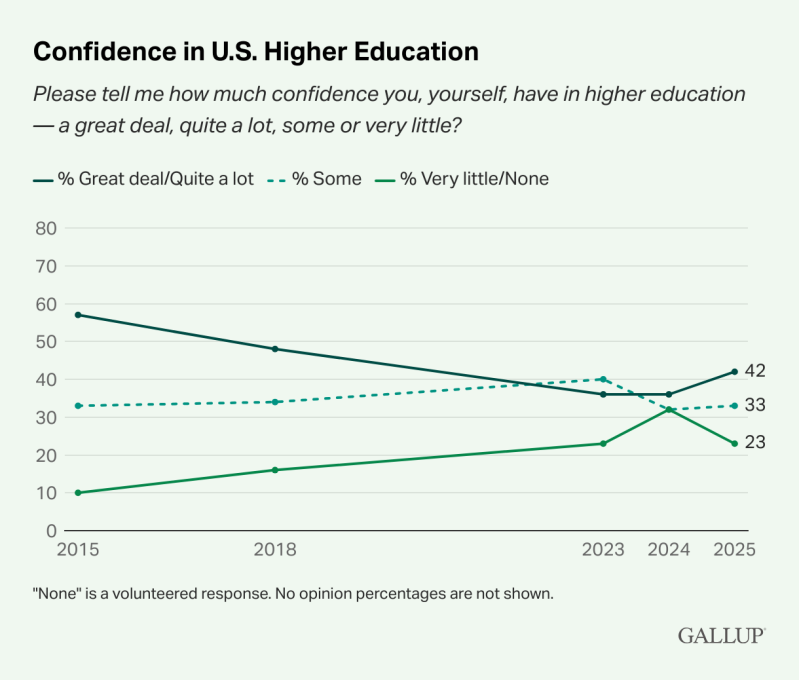
Source: Gallup